Maa Sitala, Maa Manasa, and the Bad Public Health Architecture of Fear
Acronyms expanded in this post:
- AI: Artificial Intelligence. software that generates, classifies, predicts, summarizes, or acts on patterns in data.
- FHIR: Fast Healthcare Interoperability Resources. the modern web-friendly Health Level Seven healthcare data exchange standard.
- HL7: Health Level Seven. the family of healthcare messaging and data exchange standards.
- HL7 v2: Health Level Seven version 2. the older event-message standard still running much hospital integration.
- IT: Information Technology. the practice of building, operating, and supporting computing systems.
A society that turns smallpox and snakebite into goddesses is not being quaint; it is building an emergency operating system with the materials it has.
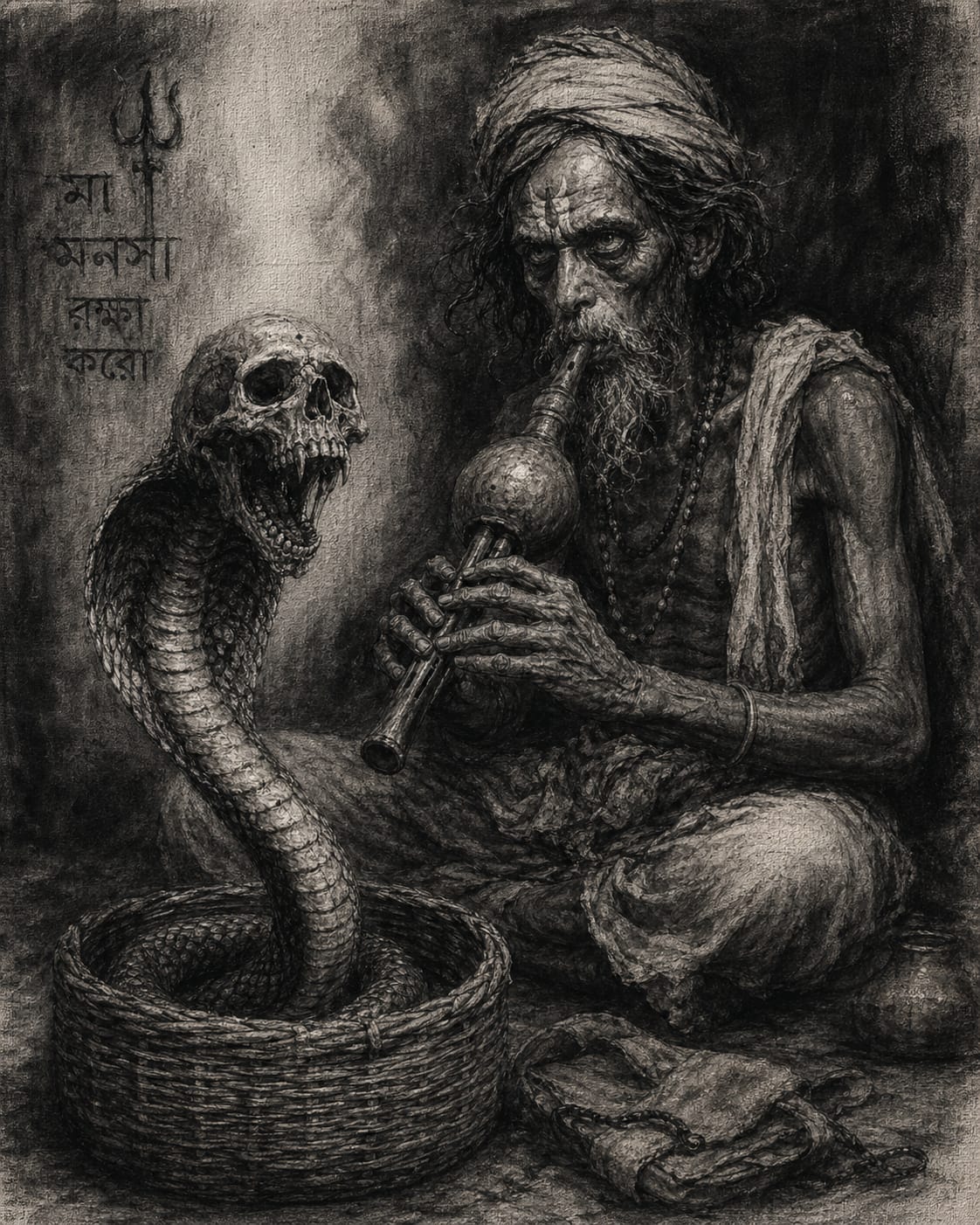
Maa Sitala and Maa Manasa belong to that old, crowded, half-lit region where disease, ecology, caste, gender, fear, medicine, and priestly absorption all sit on the same mud floor. Sitala is the cooling mother of pox, pustules, fever, sores, and epidemic terror. Manasa is the snake goddess, the poison-controller, the rural negotiator between humans and the venomous world that creeps through paddy fields, ponds, thatch, and monsoon grass. These figures were not born as tidy textbook Hindu deities with laminated divine résumés. They came from local cults, village shrines, non-Vedic practice, folk memory, women’s ritual labor, tribal and subaltern religious imagination, and the practical need to explain sudden death before germ theory or antivenom had entered the village like a late government jeep.
The important point is not that rural people were foolish. The important point is that terror requires form. Smallpox did not arrive as “Variola major, an Orthopoxvirus transmitted through respiratory droplets and lesion material.” It arrived as a child burning with fever, eyes swollen, skin erupting, neighbors whispering, household rhythm broken, and the terrible arithmetic of who might be next. Snakebite did not arrive as “envenomation requiring species-aware clinical evaluation, pressure immobilization in some cases, and rapid access to antivenom.” It arrived as a farmer collapsing near a field bund while the village counted distance, money, transport, daylight, and caste access to the nearest facility. A goddess is often the village’s first data model for catastrophe: not biologically correct, but socially usable.
Sitala’s name carries the idea of coolness, and that matters. A hot disease needed a cooling mother. Her broom, water pot, neem leaves, donkey, and association with pustular disease form a rough symbolic epidemiology. The broom cleans; the water cools; neem suggests purification; the donkey carries the unwanted; the goddess both afflicts and cures. That contradiction is not theological clumsiness. It is exactly how epidemic disease feels before science gives it mechanism. The same force that strikes must be placated to withdraw. The disease is not merely a pathogen; it is a relationship. In this older grammar, health is negotiated, not engineered.
Manasa’s world is different but related. Bengal is snake country because it is water country, rice country, mud country, monsoon country. Snakes are not exotic beasts there; they are infrastructure with fangs. They live in the same ecological system as the farmer, fisher, cow, granary, pond, and child. Manasa emerges from that world as a local serpent power, often treated by scholars as non-Vedic, tribal, or folk in origin before being drawn into broader Hindu genealogies. The Manasamangal poems did much of this cultural engineering. They did not merely praise a goddess; they negotiated her legitimacy. They staged the fight between a local deity demanding recognition and a merchantly, patriarchal, higher-status order reluctant to bow. That is theology, yes, but also social integration wearing a conch shell.
Brahminical incorporation was the old subcontinent’s great religious middleware. Local deities did not simply disappear when Sanskritic Hinduism expanded; many were mapped, renamed, married, parented, reclassified, and given respectable divine paperwork. A village goddess could become a form of Parvati, a daughter of Kashyapa, a consort in a Puranic genealogy, a manifestation of Devi, or a power assigned a slot in the cosmic bureaucracy. This process is often called Sanskritization, but that word can make it sound cleaner than it was. It was not a software upgrade. It was a political merger, a semantic migration, and occasionally a hostile acquisition.
The less obvious machinery underneath is that religious absorption and healthcare standardization fail in similar ways when they confuse transport with meaning. A myth can travel from shrine to scripture, but its meaning changes when it moves from a low-caste village ritual into a Brahmin-supervised pantheon. A clinical fact can travel from a village encounter into a Health Level Seven version 2 [HL7 v2, a widely used older healthcare messaging standard that moves clinical events between systems] message, a Fast Healthcare Interoperability Resources [FHIR, a modern standard that represents clinical data as modular resources exchanged through application programming interfaces] resource, or a government dashboard, but the meaning changes if the system loses context. Transport is the movement of a representation. Meaning is the human, clinical, social, temporal, and institutional reality that made the representation matter in the first place.
This is why rural superstition cannot be defeated by mockery. Mockery is the cheapest medicine ever invented, which is why it cures nothing. A villager who goes to a shrine, then to a quack, then perhaps to a government clinic is not necessarily choosing metaphysics over science in some neat philosophical referendum. Often he is choosing what is nearby, open, socially legible, affordable, and willing to touch him. The qualified doctor may be twenty kilometers away. The Primary Health Centre [PHC, the basic government facility intended to provide first-contact primary care] may be under-staffed, under-supplied, or closed when needed. The Community Health Centre [CHC, a larger referral-level public facility meant to provide specialist and emergency support] may exist on paper with the serene optimism of a railway timetable during a flood. The quack is present. The goddess is present. The state is sometimes a rumor.
That is the brutal public health lesson. Superstition survives not only because people believe false things, but because institutions fail to make true things reachable. Germ theory does not help a mother if the vaccine session is erratic, the nurse is absent, the road is broken, the ambulance number does not answer, and the man with the injection bag arrives in ten minutes. Antivenom does not help if the patient is bounced between facilities, if the clinician is unsure, if the stockout is discovered after the journey, or if the family has already lost the golden hours to chanting, cutting, sucking, burning, or the local poison-man who inherited confidence but not pharmacology.
Quacks and charlatans occupy the gap between formal design and lived availability. They are dangerous not because all of them are cartoon villains twirling moustaches over expired antibiotics, though India produces that species with industrial enthusiasm. They are dangerous because they become unofficial architecture. They prescribe antibiotics, steroids, analgesics, sedatives, intravenous fluids, and injections with the swagger of men who have discovered that a white coat can be cheaper than a degree. They create antimicrobial resistance, mask severe illness, delay referral, normalize irrational polypharmacy, and teach the population that medicine is something wet, injectable, immediate, and dramatic. The body becomes a stage. The syringe becomes theatre. The bill becomes proof of seriousness.
But again, the supply of charlatans is coupled to the demand created by absence. Rural healthcare often functions as a broken queueing system. The poor cannot wait endlessly because waiting has a cost: lost wages, transport, meals, humiliation, debt, and the risk of being told to come tomorrow. The unqualified practitioner wins not by being medically right but by being logistically intimate. He knows the family, speaks the dialect, extends credit, arrives at night, and provides certainty where science properly provides probabilities. In a system designed by PowerPoint and lived by fever, certainty has market value.
This is where representation failures are often mislabeled as data quality failures. A district report may say that a PHC exists, that a physician post is sanctioned, that immunization coverage is high, that snakebite deaths are low, or that outpatient visits have increased. Then someone notices that field reality does not match the dashboard and says, “The data quality is poor.” Sometimes it is. But often the deeper failure is representational. The data model says “facility,” but the village experiences “a locked building.” The data model says “doctor posted,” but the patient experiences “doctor unavailable.” The data model says “vaccinated,” but the household experiences “not sure what was given.” The data model says “snakebite case,” but the death certificate says something vaguer, if a death certificate exists at all. The problem is not only wrong data. It is a wrong map of what should count as reality.
In healthcare information systems, this distinction matters enormously. A rural public health platform can transport vaccine events, lab results, drug stock, bed capacity, referral notes, ambulance logs, and mortality statistics. That is useful. But if the system does not encode provenance, availability, time delay, care-seeking sequence, informal treatment before arrival, caste and gender barriers, local healer involvement, and stockout uncertainty, it will produce a polished lie. The lie will have clean columns. It may even have a dashboard in soothing colors. Bureaucracy loves a well-formatted mirage.
The old disease goddesses understood something modern systems often forget: illness is social before it is administrative. Sitala’s household rituals created isolation, cooling, care, fear management, and communal recognition, though wrapped in wrong causality. Manasa’s worship encoded the seasonal risk of snakes during monsoon months and the need to respect an ecological danger. The scientific problem is that rituals do not neutralize viruses or venom. The architectural problem is that modern medicine often neutralizes mechanism but fails to replace the social functions of ritual: explanation, proximity, trust, continuity, and accountable presence.
Smallpox is the great corrective example. The disease was not defeated by telling Indians that Sitala was nonsense. It was defeated by vaccination, surveillance, case detection, containment, field logistics, political will, and relentless public health operations. But cultural translation mattered. Public health workers had to enter a world where Sitala was already the local interface to pox. The successful strategy was not pure laboratory truth marching into the village with a trumpet. It was truth carried through cold chains, records, persuasion, local workers, posters, needles, negotiations, and repeated human contact. Science won because it became operational, not because it was philosophically superior in a seminar room.
Snakebite remains a more neglected tragedy because it sits in the rural margins: agricultural, monsoon-linked, poor, undercounted, and clinically time-sensitive. Manasa still receives prayers because snakes still bite and systems still fail. A practical health architecture would not waste time insulting Manasa worshippers. It would map snakebite hotspots, stock antivenom rationally, train first-contact providers, establish referral pathways, educate communities on what not to do, monitor outcomes, and record the ugly pre-hospital chain where so much mortality is decided. It would treat local belief not as a decorative anthropology appendix but as part of the operating environment.
The same applies to pox-like disease scares, vaccine hesitancy, fever outbreaks, maternal care, mental health, tuberculosis, diabetes, and antimicrobial misuse. A rural patient does not experience “the healthcare system” as one system. He experiences fragments: Accredited Social Health Activist [ASHA, a community health worker who connects households with public health services], Anganwadi worker, auxiliary nurse, pharmacist, informal practitioner, temple, private clinic, government hospital, ambulance, cousin with a motorcycle, WhatsApp rumor, and the family elder who knows exactly the wrong thing with magnificent confidence. That is the real care network. Any architecture that omits it is not rigorous. It is just tidy.
The design implication is uncomfortable but clear. Rural health systems must include informal reality without legitimizing dangerous practice. That means separating surveillance from punishment in some settings so families report early treatment truthfully. It means training community workers to ask, without contempt, what was already given: injection, steroid, antibiotic, herbal paste, ritual cutting, sedative, unknown tablets, or local antidote. It means making referral notes capture delay and prior intervention. It means designing clinical decision support for low-resource triage rather than fantasy tertiary-care workflows. It means inventory systems that show antivenom and vaccine availability as usable, current, and geospatially meaningful, not as stock entries aging quietly in some clerical cupboard.
Governance also has to be honest about incentives. If unqualified practitioners are simply banned without replacing their accessibility, the practice goes underground. If they are ignored, patients are harmed. If they are loosely “trained” without boundaries, the state may accidentally launder quackery into semi-official medicine. The path is narrow and muddy. It requires registration, role restriction, referral incentives, public education, enforcement against dangerous procedures, and expansion of real primary care. The neat solution runs into workforce shortages, uneven distribution of clinicians, poor infrastructure, poverty, political patronage, weak enforcement, and the unpleasant fact that many rural citizens have learned through experience that the nearest formal system may not behave like a system at all.
Under the floorboards, the truth is that Maa Sitala and Maa Manasa persist because they are not merely myths. They are evidence. They record centuries of disease before microbiology, venom before toxicology, care before clinics, and fear before the state learned to count the rural poor except during elections. Brahminical absorption gave them theological respectability, but their original power came from practical dread. The shrine stood where the health system did not. The ritual spoke where the doctor was absent. The goddess explained what the administration ignored.
The task now is not to romanticize folk religion or to pretend superstition is harmless. It is not harmless when it delays vaccination, obstructs antivenom, encourages magical cures, protects quacks, or turns suffering into divine punishment. Nor is the task to sneer at the believer from the safe altitude of urban broadband. The task is to build systems so dependable that superstition loses its practical monopoly. People abandon bad explanations faster when good institutions arrive on time.
A modern public health architecture for rural India has to be part clinic, part logistics network, part trust engine, part data system, and part anthropological listening post. It must know the difference between a deity and a pathogen, but also the difference between a database row and a lived event. It must move vaccines, antivenom, clinicians, diagnostics, and records. It must also move meaning: why the injection matters, why delay kills, why fever with rash must be reported, why snakebite needs a facility and not a blade, why antibiotics are not holy water, why a steroid shot that makes someone briefly feel better can be a small invoice written by the devil.
Maa Sitala and Maa Manasa should be studied not because they are quaint relics but because they reveal the old Indian contract between danger and explanation. The tragedy is that in too many places the contract has not been replaced by a better one. The village still bargains with pox, poison, fever, and fraud. The goddess has at least the courtesy to be mythic. The quack arrives with a stethoscope.